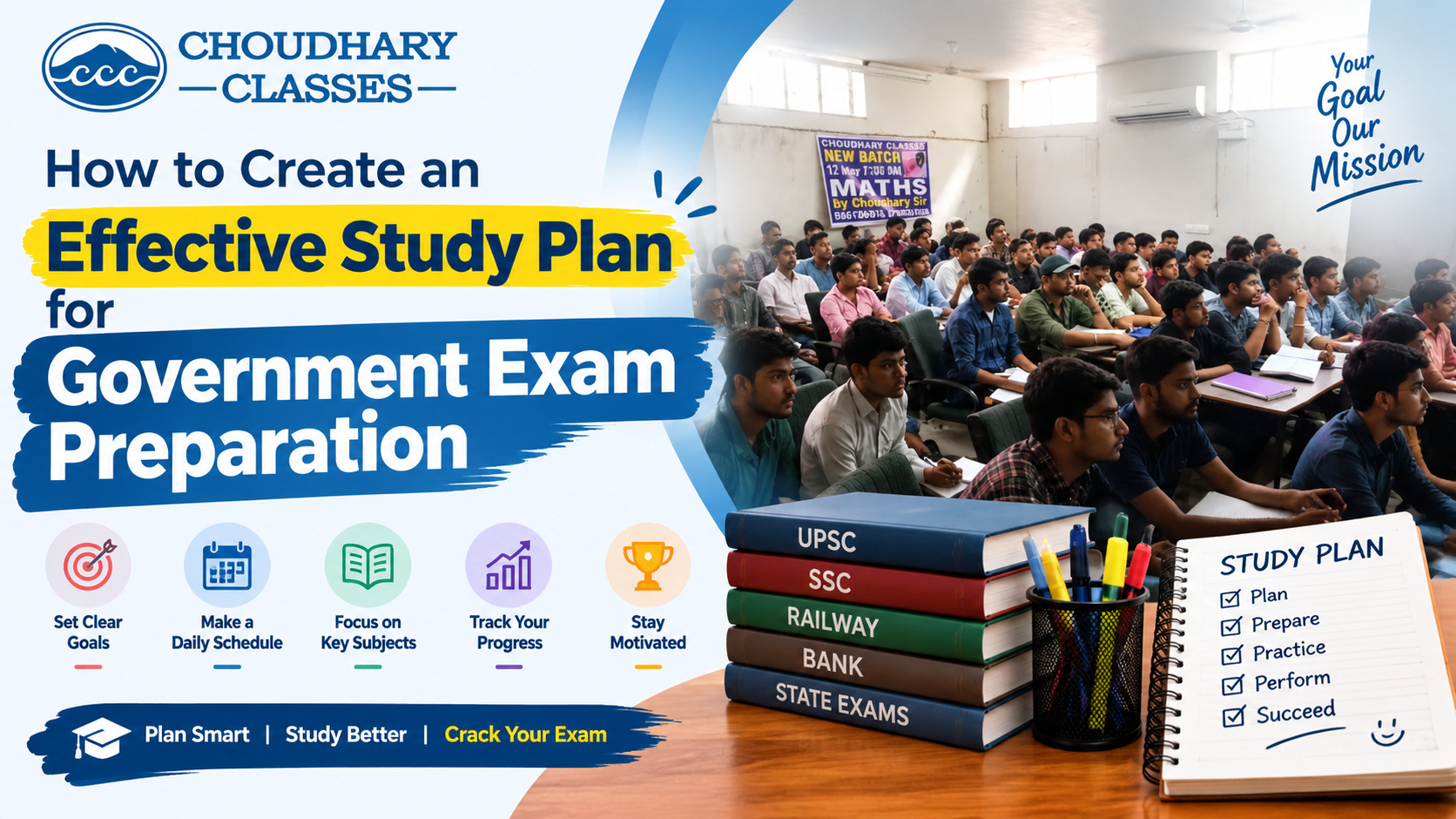
How to Create an Effective Study Plan for Government Exam Preparation
Preparing for a government exam requires more than hard work. It demands a clear strategy, consistent practice, effective time management, and a well-structured study routine. Whether you are preparing for SSC, Railway, Banking, Rajasthan Administrative Services (RAS), or other competitive examinations, a practical study plan can help you cover the syllabus systematically and improve your performance.
Many aspirants spend hours studying but struggle to achieve their desired results because they lack proper planning. An effective government exam study timetable helps you prioritise important topics, revise regularly, practise mock tests, and track your progress. With guidance from a Top Government Exam Coaching Jaipur, students can also develop disciplined study habits and learn exam-specific preparation strategies.
In this blog, we will explore how to create a realistic study plan, manage your daily schedule, overcome common preparation challenges, and build a focused approach to government competitive exam preparation.
1. Understand the Exam Pattern and Syllabus
The first step towards effective preparation is understanding your target examination. Every government exam has a different syllabus, marking scheme, difficulty level, and selection process. Before creating a timetable, review the official notification and syllabus carefully.
Identify the subjects, topics, number of questions, examination duration, negative marking rules, and stages of selection. For example, SSC examinations generally assess areas such as Quantitative Aptitude, General Intelligence and Reasoning, English, and General Awareness, while banking examinations may place additional emphasis on data interpretation and banking awareness.
Divide the syllabus into three categories: topics you understand well, topics that require more practice, and topics you find difficult. This classification helps you allocate study time according to your needs.
A clear understanding of the syllabus also prevents unnecessary studying and keeps your government exam preparation strategy aligned with the actual examination requirements.
2. Set Clear and Achievable Study Goals
A successful study plan begins with specific, measurable goals. Instead of setting a vague target such as studying for eight hours daily, decide what you want to accomplish during each session.
For example, your daily targets could include completing two reasoning topics, solving 40 mathematics questions, learning 20 new vocabulary words, and revising one current affairs topic.
Break your preparation goals into three levels:
- Long-term goals: Complete the entire syllabus within a defined period.
- Weekly goals: Finish selected chapters, practise sectional tests, and revise previously studied concepts.
- Daily goals: Complete specific lessons, solve practice questions, and review mistakes.
Make your targets realistic according to your current knowledge, available time, and exam date. If you are preparing for multiple examinations, prioritise those with overlapping syllabi while reserving time for exam-specific subjects.
Students enrolled in a Government Job Coaching Institute Jaipur can use these goals alongside classroom lessons, assignments, and regular assessments to maintain consistency.
3. Create a Practical Government Exam Study Timetable
A well-designed timetable gives structure to your preparation without making your day unnecessarily stressful. Your daily study schedule for government exams should include concept learning, question practice, revision, mock tests, breaks, and sufficient sleep.
Here is a sample timetable for an aspirant who can dedicate approximately seven focused study hours daily.
| Time | Study activity |
| 7:00–8:00 AM | Current affairs and General Awareness |
| 8:15–10:00 AM | Quantitative Aptitude or Mathematics |
| 10:00–10:30 AM | Break |
| 10:30 AM–12:00 PM | Reasoning and problem-solving |
| 12:00–1:00 PM | English or Hindi |
| 1:00–2:00 PM | Lunch and rest |
| 2:00–3:00 PM | Subject-specific topics |
| 3:15–4:15 PM | Practice questions and sectional tests |
| 7:00–7:30 PM | Revision and error analysis |
This is a sample routine, not a fixed rule. Adjust the timings to your school, college, job, coaching classes, energy levels, and examination requirements. The schedule includes approximately seven hours of focused study.
The best study routine for government exams is one that you can follow consistently. If you concentrate better in the morning, schedule difficult subjects early. If you attend coaching classes during the day, use your available hours for revision and independent practice.
4. Prioritise Subjects According to Difficulty and Importance
Not every subject requires the same amount of preparation time. Some topics may be easy to understand but require regular revision, while others may demand extensive practice.
Allocate more time to subjects where you consistently make mistakes. At the same time, avoid ignoring your stronger subjects because maintaining proficiency in them can help improve your overall score.
A practical approach is to divide your preparation into three study blocks:
- Concept learning: Understand formulas, rules, theories, and fundamental principles.
- Practice sessions: Solve previous-year questions, topic-wise exercises, and timed quizzes.
- Revision sessions: Review formulas, important facts, vocabulary, and frequently repeated mistakes.
For instance, if mathematics is your weakest subject, dedicate additional time to arithmetic and data interpretation while maintaining regular English and reasoning practice.
A selection-oriented preparation approach focuses on improving accuracy, speed, and subject knowledge together rather than spending excessive time on one topic.
5. Use Previous-Year Papers and Mock Tests Strategically
Reading textbooks and watching lectures can build conceptual understanding, but examination performance also depends on how effectively you apply that knowledge under time pressure.
Previous-year question papers help you understand question patterns, recurring topics, difficulty levels, and the way concepts are tested. Mock tests allow you to practise completing questions within the prescribed time limit.
Follow this process:
- Solve topic-wise questions after completing each chapter.
- Attempt sectional tests to evaluate individual subjects.
- Take full-length mock tests at regular intervals.
- Analyse incorrect answers and identify the reason behind each mistake.
- Revisit weak concepts and practise similar questions before taking another test.
Do not measure progress only by your mock test score. Also monitor accuracy, time spent per question, unanswered questions, and repeated errors.
For effective government exam syllabus preparation, use mock test analysis to decide what you should study next. This makes your preparation more targeted and helps you avoid repeating the same mistakes.
6. Make Revision a Daily Habit
One common mistake in government exam preparation is continuously learning new topics without revisiting previously studied material. Over time, this can lead to forgotten formulas, confusion between concepts, and difficulty recalling important facts during the examination.
A structured revision system helps strengthen memory and improve recall.
Try revising a topic on the day you learn it, again after a few days, and once more the following week. You can use short notes, flashcards, formula sheets, mind maps, and practice quizzes to make revision faster.
For General Awareness and current affairs, maintain concise notes containing important national events, government schemes, awards, appointments, sports updates, and other examination-relevant information.
Keep the final weeks before your examination primarily focused on revision, mock tests, and weak areas instead of starting numerous unfamiliar resources.
Consistent revision is one of the most practical government exam preparation tips for retaining information and building confidence.
7. Improve Time Management and Maintain Consistency
Time management for government exam preparation involves more than creating a timetable. It also means reducing distractions, avoiding unnecessary tasks, and using your study hours effectively.
Start by setting specific periods for focused study. Keep your phone away during these sessions, disable unnecessary notifications, and take short breaks between demanding tasks.
The Pomodoro technique is one option: study for 25 minutes, followed by a five-minute break. If you can maintain concentration for longer periods, try 45–50 minutes of focused work followed by a 10-minute break.
You should also:
- Avoid collecting too many books, apps, and online resources.
- Set a daily target for question-solving practice.
- Track completed topics and pending tasks.
- Maintain a consistent sleep schedule.
- Include light physical activity and relaxation in your routine.
Remember that consistency matters more than occasional marathon study sessions. A manageable schedule followed regularly is generally more sustainable than an extremely demanding timetable that you abandon after a few days.
8. Choose the Right Guidance and Learning Environment
Self-study is essential, but structured guidance can help aspirants understand difficult concepts, identify preparation gaps, and maintain accountability.
A Competitive Exam Coaching Institute in Jaipur may provide subject-wise classes, doubt-solving sessions, practice tests, previous-year question discussions, and regular performance assessments. These resources can be particularly useful for beginners who need a clear starting point.
When evaluating a coaching institute, consider the faculty's subject expertise, the relevance of the study material, the frequency of mock tests, batch size, doubt-clearing support, and the quality of individual feedback.
For students who need a highly structured routine, Selection Oriented Coaching Jaipur can be a relevant search when comparing programmes that emphasise examination practice, time management, and performance improvement.
However, coaching alone does not guarantee selection. Your results depend on several factors, including preparation quality, consistency, accuracy, exam strategy, and performance on the examination day. Choose support that complements your independent study rather than replacing it.
9. Track Your Progress and Update Your Study Plan
An effective study plan should evolve as your preparation improves. Review your performance every week to identify completed topics, remaining syllabus, accuracy levels, and areas requiring additional attention.
For example, if your reasoning scores improve consistently but your mathematics accuracy remains low, adjust your next week's timetable to include more mathematics practice and error analysis.
Use a simple weekly progress tracker:
| Preparation activity | Weekly target |
| Syllabus coverage | Complete planned chapters |
| Practice questions | Meet a realistic question target |
| Mock tests | Attempt and analyse scheduled tests |
| Revision | Review all completed topics |
| Weak areas | Practise recurring mistakes |
Avoid changing your entire strategy after one disappointing mock test. Look for repeated patterns across several assessments before making significant adjustments.
This flexible approach helps you stay accountable while ensuring that your preparation remains focused on measurable improvement.
Conclusion
Creating an effective study plan for government exam preparation is about combining clear goals, syllabus-based planning, regular practice, revision, and disciplined time management. By following a realistic government exam study timetable, analysing mock tests, and reviewing your progress each week, you can make your preparation more organised and productive.
Whether you are a beginner or an experienced aspirant, focus on building strong fundamentals and improving your performance step by step. If you need additional structure, consider Government Exam Coaching option that offers relevant study material, experienced guidance, and regular assessments
Ultimately, a successful preparation strategy is not about studying every hour of the day. It is about using your available time wisely, learning from mistakes, and maintaining consistency until examination day.