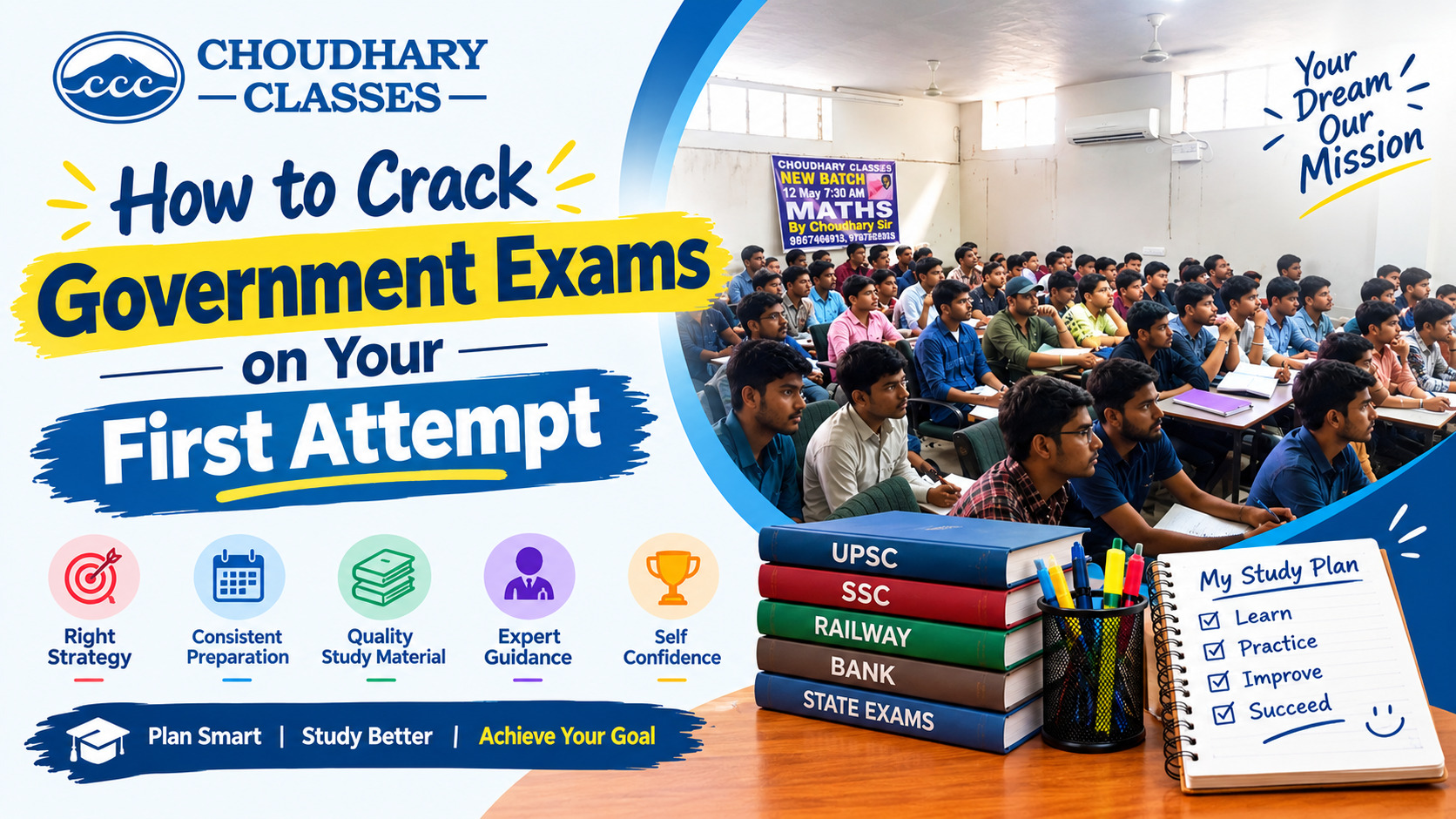
How to Crack Government Exams on Your First Attempt
Cracking a government exam on your first attempt is an achievable goal with the right preparation strategy, consistent practice, and effective time management. Whether you are preparing for SSC, Banking, Railway, Rajasthan Administrative Services (RAS), or other competitive examinations, success depends on understanding the exam pattern, building strong fundamentals, practising mock tests, and analysing your performance regularly.
For many aspirants, the biggest challenge is not a lack of hard work but the absence of a structured study plan. Studying for long hours without clear priorities can lead to stress, confusion, and incomplete preparation. A well-planned approach helps you focus on important topics, improve accuracy, and prepare confidently for every stage of the selection process.
If you are beginning your government exam preparation journey, these practical strategies will help you develop an effective routine, avoid common mistakes, and move closer to your dream government job.
1. Understand the Exam Pattern and Syllabus
The first step towards first attempt government exam preparation is understanding exactly what you need to study. Every competitive examination has a different syllabus, marking scheme, selection process, and difficulty level.
For example, SSC examinations generally assess quantitative aptitude, reasoning, English, and general awareness. Banking examinations may include data interpretation, financial awareness, and sectional time limits, while RAS requires a broader understanding of history, geography, polity, economics, and current affairs.
Before starting your preparation, download the official notification and syllabus. Identify the examination stages, total marks, negative marking rules, and time limits. Divide the syllabus into manageable sections and prioritise topics according to their importance and your current skill level.
Pro tip: Avoid preparing for multiple unrelated examinations without a clear plan. Choose exams with overlapping syllabi to make your study efforts more efficient.
2. Create a Realistic Government Exam Study Plan
A practical government exam study plan provides direction and helps you maintain consistency. Instead of studying randomly, assign specific time slots to individual subjects, revision, and practice.
For instance, a beginner may dedicate two hours to quantitative aptitude, one hour to reasoning, one hour to English, and another hour to general awareness. The remaining time can be used for mock tests, revision, or analysing mistakes. Adjust this schedule according to your exam requirements and available study hours.
Set weekly targets rather than relying only on daily goals. Complete a defined number of chapters, solve practice questions, and revise previously studied concepts before moving to new topics.
Your schedule should also include short breaks and adequate sleep. A sustainable routine is more effective than an exhausting timetable that becomes difficult to follow after a few days.
3. Strengthen Your Basic Concepts
One of the most important government exam preparation tips is to build strong fundamentals before attempting advanced questions. Many aspirants rush towards difficult practice sets without understanding the underlying concepts, which leads to repeated mistakes.
Start with the basics of mathematics, grammar, logical reasoning, and general studies. Use reliable textbooks, previous-year question papers, and subject-specific learning resources to understand important concepts.
Once your fundamentals are clear, gradually increase the difficulty of your practice questions. Learn shortcut techniques only after understanding the standard methods, as shortcuts without conceptual clarity can increase errors under exam pressure.
For general awareness, maintain concise notes on important national events, government schemes, Indian polity, history, geography, and other syllabus-related subjects. Regular revision will help you retain information more effectively.
4. Practise Previous-Year Question Papers
Previous-year question papers are essential for understanding the actual examination. They reveal recurring topics, question formats, difficulty levels, and the time required to solve different sections.
Solve papers under exam-like conditions rather than checking answers after every question. This helps you identify knowledge gaps and understand how effectively you manage time.
After completing each paper, analyse your performance. Categorise mistakes into three groups: conceptual errors, calculation errors, and time-management errors. Revise the relevant topics and solve similar questions to prevent the same mistakes from recurring.
Although previous papers help identify patterns, do not assume that the same questions will appear again. Use them to understand the examination structure and improve problem-solving skills.
5. Take Mock Tests and Analyse Your Performance
Mock tests are a valuable part of government competitive exam preparation because they simulate the pressure and time constraints of the actual examination.
Begin with one or two mock tests per week and increase the frequency as your preparation improves. During the initial stage, focus on accuracy and understanding. Closer to the examination, practise full-length tests within the official time limit.
Pay attention to your score, accuracy, unanswered questions, and time spent on each section. Identify which topics consume too much time and which questions you should skip rather than attempt blindly.
Maintain a mock-test performance tracker to monitor your progress. Your goal should be consistent improvement, not simply completing a large number of tests.
Remember: Taking a mock test without analysing your mistakes reduces its value. Reviewing every test carefully is what turns practice into measurable improvement.
6. Improve Time Management and Accuracy
Government examinations often test not only your knowledge but also your ability to make quick, accurate decisions. Effective time management is therefore a critical part of the best strategy for government exams.
Start by identifying your strongest and weakest subjects. Allocate more practice time to weaker areas while maintaining your performance in stronger ones.
During mock tests, learn to recognise questions that can be solved quickly and those that require more time. Avoid spending several minutes on a single difficult question when easier questions are available elsewhere.
If the examination includes negative marking, avoid random guessing. Attempt questions when your knowledge and elimination techniques provide a reasonable basis for choosing an answer.
Regular timed practice will help you develop speed without sacrificing accuracy.
7. Revise Regularly and Stay Updated with Current Affairs
Studying a topic once is rarely enough to retain it until examination day. A structured revision routine helps strengthen memory and reduces the need to relearn entire chapters.
Revise important concepts at regular intervals. Create short notes, formula sheets, vocabulary lists, and summaries of difficult topics. These resources are especially useful during the final weeks before the examination.
For current affairs, follow reliable news sources and monthly compilations relevant to your examination. Focus on important national and international developments, government initiatives, awards, appointments, sports, and economic updates where applicable.
Avoid collecting information from too many sources. A limited number of reliable resources, combined with consistent revision, is usually more manageable and productive.
8. Avoid Common Mistakes During Preparation
Even hardworking candidates can struggle when their preparation lacks direction. Avoid these common mistakes to make your efforts more effective:
- Changing study materials frequently: Choose reliable resources and complete them before switching to alternatives.
- Ignoring weaker subjects: Give additional practice time to topics where your performance is consistently low.
- Skipping revision: Reserve dedicated time every week to revisit completed topics.
- Studying without practice: Balance conceptual learning with timed questions and mock tests.
- Comparing yourself with others: Track your own progress instead of judging your preparation by someone else's schedule.
- Ignoring official notifications: Check eligibility, application deadlines, exam dates, and syllabus updates on the relevant official website.
Maintaining discipline, reviewing your progress, and correcting mistakes will help you build a more effective preparation strategy.
9. Consider Guidance from an Experienced Coaching Institute
Self-study can be effective, but some aspirants benefit from structured classes, expert guidance, doubt-solving sessions, and regular assessments. A suitable coaching programme can provide a timetable, organised study material, competitive practice, and feedback on performance.
When evaluating the Top Government Exam Coaching options, look beyond promotional claims. Compare faculty experience, batch size, teaching methodology, mock-test quality, doubt-clearing support, and the relevance of the course to your target examination.
A reliable Government Job Coaching Institute Jaipur should help students understand concepts, practise systematically, and identify areas for improvement. Aspirants who prefer structured preparation may also consider a Selection Oriented Coaching Jaipur programme that combines syllabus coverage, exam-focused practice, revision, and performance evaluation.
Similarly, when choosing a Competitive Exam Coaching Institute in Jaipur, check whether its teaching approach matches your learning needs and whether it provides realistic guidance about the selection process.
Coaching should complement your personal effort, not replace it. Before enrolling, review the course structure and verify selection-related claims wherever possible.
10. Stay Consistent, Confident, and Focused
Government exam preparation is a long-term commitment that requires patience and discipline. There may be days when progress feels slow, but consistent effort produces better results than irregular bursts of intense studying.
Set achievable daily targets, take care of your physical well-being, and maintain a positive approach towards learning. Use setbacks as opportunities to identify weaknesses and refine your preparation strategy.
As the examination approaches, avoid making major changes to your study routine. Focus on revision, mock tests, important concepts, and maintaining a calm mindset.
Remember that your first attempt is an opportunity to apply everything you have learnt. With proper planning, focused practice, and continuous improvement, you can give yourself a stronger chance of success.
Conclusion
Cracking government exams on your first attempt requires more than studying for long hours. It involves understanding the syllabus, building strong fundamentals, following a realistic study plan, solving previous-year papers, taking mock tests, and revising consistently.
Start with a clear goal, measure your progress, and make improvements based on your performance. Whether you choose self-study or guidance from a coaching institute, your preparation should remain disciplined, practical, and aligned with the official examination requirements.
Your government job preparation starts with one focused step. Plan wisely, practise consistently, and turn your ambition into a well-prepared attempt